
This site is best experienced on a desktop or laptop computer.
Providing online therapy throughout California

Based in Humboldt County, California

"Rivers know this: there is no hurry. We shall get there some day."
— A.A. Milne
Who I work best with

You don't need to be in crisis.

You're anxious, and it's affecting your life.
It feels like more than just worry — it follows you into bed, into conversations, into decisions that pile up over time. You're ready to start looking at this with someone.
Learn more →
You're going through something hard.
Divorce, loss, a relationship falling apart, a version of yourself that you find troubling. Something has changed and you want to start finding your way forward again.
Learn more →
You've been feeling low for a while.
Depression is very common and shows up in so many ways. It's shaped by so many variables... we can tackle this together.
Learn more →
You've been leaning on something to get through.
Substances, a habit you're not proud of. These things start as a way to cope and can become their own problem... we can work on this.
Learn more →
You carry a lot from the past.
Old patterns keep showing up. Relationships feel familiar in ways that don't work well anymore. You suspect the past has more to do with the present than it should.
Learn more →
You think a lot — maybe too much.
You analyze, revisit, second-guess. That's a lot of mental noise and it can be exhausting. You want someone who can help you turn the volume down and get to the core of it.
Learn more →
You're not sure therapy is for you.
Maybe you've never tried therapy before, or it didn't go how you wanted the last time. Those are perfect starting points.
Learn more →
What it actually looks like

If we work together.

Starting out
The first few sessions are about getting the most complete picture I can — what brought you in, what's happened before, how things are going physically. Getting to know my clients is a process that takes a lot of time, and I understand the delicacy of balancing self-disclosure and trust. I use a few screening tools early on — they can help orient us, sometimes point us in a direction worth exploring. Mostly I just want to listen.
The body matters
I've worked with people who came in exhausted and depressed, and it turned out anemia or low vitamin D was a significant piece of it. I've worked with people whose anxiety had a hyperthyroid component no one had caught. People are wonderfully complex — and if the physical piece hasn't been explored, I think it's worth looking at. I might ask about bloodwork at some point — thyroid, vitamin D, anemia — and how sleep is going. It's okay if you don't know your numbers or your history. I may also ask about sleep, movement, screen time, daylight, drugs and alcohol. You can share whatever you're comfortable sharing. Therapy is a process, and building trust takes time.
What we actually do together
This is harder to summarize, because it depends on you. Some people want to understand — where their patterns came from, why certain things keep happening, what the past has to do with the present. Others need something more immediate — to slow down, to notice what or how their body is holding stress, to find a little breathing room before anything else is possible. Most people find we move between both, sometimes in the same session.

I follow what you need rather than a predetermined method. Some sessions are quiet and exploratory. Some have more structure. What I care about most is that something actually happens for you — that you leave feeling like the hour meant something.
Between sessions
I might suggest something to try, watch, read, or notice before we meet again. Call it homework or an experiment — either way, those efforts tend to matter. What you bring back is often some of the most useful material we work with.
On duration
Most people work with me somewhere between a few months and a year or more — it varies a lot. I hope we can check in regularly about how you're feeling, whether our work has traction, whether something needs to be different for you. If it's not the right fit, we can definitely talk about that. I'm glad to adjust, or if it makes sense, help you find someone who might serve you better.
A note on privacy
Therapy is private and confidential — with some important exceptions. I'm a mandated reporter, which means I'm required by law to report suspected abuse or neglect of children and certain other protected groups. I'll explain all of this in our first session, including the other circumstances under which confidentiality has limits. If you'd like to read more about California's mandatory reporting laws before we meet, you can do that here.

"And that has made all the difference."

— Robert Frost
Therapeutic approaches — in seventeen syllables

How I work, distilled.

Acceptance & Commitment — ACT
The leaf does not fight the river that's carrying it — it learns where to go.
You are not your thoughts. ACT helps you step back from all the noise of stress and self-criticism, accept what hurts without being controlled by it, and move toward the values and goals that define the life you want.
What is Acceptance Commitment Therapy? — Psych Hub
Cognitive Behavioral — CBT
The thought says: you'll fail. We ask: is that actually true? Then look again.
Thoughts are not facts. CBT helps you examine the thoughts that shape your mood (and vice versa) so that we can create more balance with this process.
How Does Cognitive Behavioral Therapy Work? — Psych Hub
Narrative Therapy

You are not the wound. You are the one who carries a pen, not a scar.
The problem is not you — it's the story built around you. We all create stories to have a framework for understanding our world. Narrative therapy helps you create new ways to think about yours.
Narrative Therapy: What It Is and What to Expect — GoodRx
Psychodynamic
What repeats in you is an old map, not the road — we can draw a new one.
The patterns that persist often began somewhere long before now. Psychodynamic work helps illuminate how the past is impacting you now.
Somatic
Before there were words the body had already known — it still speaks. Listen.
Healing isn't only cognitive. The body holds on to the past in ways that can make life harder. It can be as simple as learning to breathe in ways that dial this down.
What is Somatic Therapy? A Beginner's Guide — Dr. CB Therapy

"The woods are lovely, dark and deep…"

— Robert Frost
About Joel Morrison

Nice to meet you.

Ten years of practice. Twenty years of presence.

Joel Morrison, LCSW — Humboldt County therapist

Hi — glad you're here. I hope this gives you a sense of what working together might look like.

For the past twenty years, a significant part of my work has been sitting with people through their hardest moments — first as a social worker, then in various mental health settings alongside therapists, psychiatrists, crisis clinicians, and nurses, and now as a therapist in private practice. It's in my nature to keep learning, and that curiosity is put to good use in my work with people.

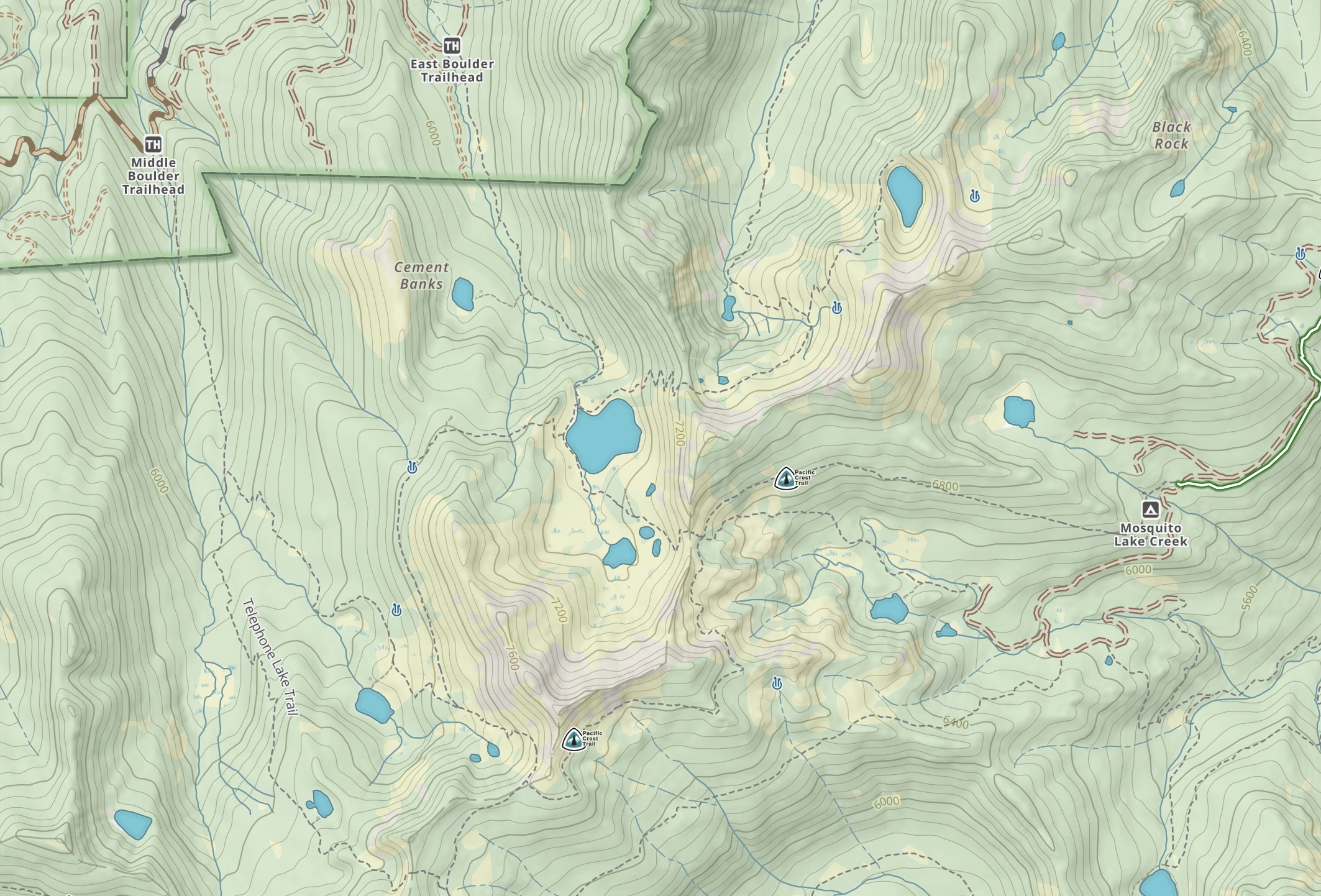
Outside of work I do pretty normal things — family, dogs, good books, good poetry when time allows, my fair share of streaming services, and getting outside when I can. (The topo map in the background is of one of my favorite areas in the Trinity Mountains.)

My goal is to help people find some relief from the cycle of difficult thoughts and emotions that they can't seem to shake. I believe pain can be a catalyst. It often points toward something that matters.

People are remarkably specific in their struggles — the exact way someone shuts down, or spirals, or talks themselves out of things. I've always found that worth paying close attention to.

I have a "come as you are" mentality when it comes to sessions. Tired, grumpy, not sure what you want to say or wanting to say it all — all of that is fine. I don't want anyone to feel like they have to perform.

I've had the privilege of working with thousands of people over the years, each one distinct. That range of experience provides the foundation for how I listen and what I notice.

Again, thanks for taking the time to read this — if something here resonates, I'd love to hear from you.
Humboldt County · Northern California
LicenseLCSW — Licensed Clinical Social Worker, California
Experience10 years licensed · 20 years social work
InsuranceKaiser Permanente · Aetna · Cigna · Medi-Cal Partnership Health Plan
ConsultationFree 20-minute consultation · I aim to return all calls the same day
LocationHumboldt County, CA · Serving clients throughout California · Telehealth only

"But I have promises to keep…"

— Robert Frost
Frequently Asked Questions

Things you might
be wondering.

Questions about cost, insurance, telehealth, what the first session looks like, how long therapy takes — and more. I've put together straightforward answers to all of it.

Self-assessment

Not sure what
you're dealing with?

These won't diagnose you but they help with getting started.

These are screening tools, not diagnostic instruments. A positive result doesn't mean you have a diagnosis — and a negative result doesn't rule one out. Results are most useful when reviewed with a clinician. This is especially true for the PCL-5, RAADS-14, and MDQ, where context and clinical judgment matter most.

Resources

Videos I
recommend.

Some of these videos touch on trauma, adversity, and difficult experiences. Approach at your own pace.
Take the next step

Ready when you are.
No pressure. No rush.

The first conversation is free, informal, and entirely on your terms.

Get in touch
I'll respond personally, usually the same day

Note: some devices may have difficulty opening email links directly. If the form doesn't submit, you can always text or call me at 707-599-7085.
Send a text
Simple, low-pressure · I'll respond personally
707-599-7085 →
Sessions most days of the week, with an emphasis on early morning starts. Email or text to ask about current openings — I aim to respond the same day.

Humboldt County, California · Serving clients throughout California · Telehealth only